The Secret Maps in Her Hair: How African Braids Carried Messages, Maps, and Freedom
Before there were letters or phones, African women were sending messages through braided patterns in their hair. Some of those patterns even mapped the way to freedom.
There is a woman sitting on a low stool. A girl sits on the ground between her knees. The woman's fingers move through the girl's hair with a rhythm that does not need thinking. She parts, pulls, crosses, and tightens. Neither of them speaks. They do not need to. This scene has been playing out across the African continent for thousands of years.
But here is what most people do not know. The pattern taking shape on that girl's head is not decoration. It is a message. Depending on the culture, the region, and the century, it could tell anyone who knows how to read it exactly who she is, where she belongs, and what stage of life she has reached. In the worst of times, it could even carry a map to freedom.
This is not legend. This is documented history. And it is extraordinary.
Hair was never just hair
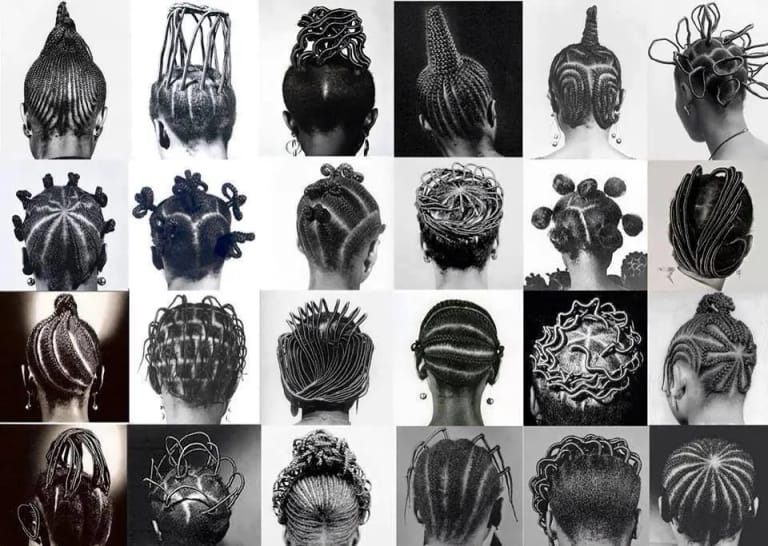
Across the African continent, long before European contact, hairstyling was one of the most important forms of social communication. The way a person's hair was braided, shaped, or adorned could say more than a conversation ever could. It was a language you wore on your head.
In the Wolof, Mende, Mandinka, Yoruba, Himba, Fulani, and dozens of other cultures, specific braiding patterns carried specific meanings. A woman's braids could indicate her ethnic group, her age, her marital status, her religion, her rank in society, and even her readiness for certain rites of passage. Hair was identity made visible.
Among the Himba people of Namibia, young girls wear their hair in two braids that fall forward over their faces. When they reach puberty, the style changes. When they marry, it changes again. A single glance at a Himba woman's hair tells you her entire life stage without a word being spoken.
In Yoruba culture, hairstyles were so significant that they had names. Each pattern carried meaning. Some were worn during festivals. Others during periods of grief. Some marked a woman as royalty. The art of braiding was passed down through generations with the same seriousness as any other form of education.
Hair was a woman's biography, written in rows and knots for the world to read.
The braiders who held communities together
The women who braided hair held a particular place in African societies. They were not simply stylists. They were keepers of cultural memory. They knew which patterns belonged to which families, which styles were appropriate for which occasions, and which designs carried spiritual protection.
Braiding sessions were gatherings. Women sat together for hours while the braider worked, and those hours became spaces for storytelling, counsel, gossip, planning, and teaching. Young girls learned their family history sitting between their mother's knees. Elders shared wisdom while their hair was styled. Conflicts were discussed and sometimes resolved during braiding sessions.
The braider's hands carried knowledge. Each twist, each crossing of strands, each carefully placed knot was an act of cultural preservation. When a braider taught her daughter how to create a certain pattern, she was not just passing on a skill. She was passing on the memory of a people.
This made hair deeply political. And when that culture was threatened, hair became something else entirely. It became resistance.
When the ships came
The transatlantic slave trade tore millions of Africans from their homelands between the 15th and 19th centuries. Among the countless things stolen from them were their names, their families, their languages, and their freedom. But there were things the slavers could not take. Memory was one of them. And hair was another.
On the ships and on the plantations, enslaved African women continued to braid. They adapted. They invented. And in some of the most extraordinary acts of quiet rebellion in recorded history, they began encoding survival itself into their hairstyles.
In Colombia, in the region around Cartagena and the palenques (communities founded by escaped enslaved people), women braided escape routes into their hair. The cornrow patterns they created were not decorative. They were maps. Specific braids indicated paths through the terrain. Curves in the rows represented rivers. Knots marked meeting points or places where food and supplies could be found.
A woman could walk through a colonial town with the entire route to freedom sitting on top of her head, and no slaveholder would ever suspect that what he saw as a hairstyle was in fact a detailed plan for escape.
Seeds hidden in plain sight
The maps were not the only thing carried in braided hair. There is another part of this history that is almost too remarkable to believe, but it is well documented.
During the Middle Passage and upon arrival in the Americas, enslaved African women hid seeds in their braids. Rice seeds, okra seeds, and seeds from other crops they knew how to cultivate. They tucked them into the tight rows of their cornrows before they were forced onto the ships, not knowing what awaited them on the other side of the ocean but knowing that if they survived, they would need to eat.
Those seeds crossed the Atlantic in the hair of enslaved women. And those seeds became the foundation of rice cultivation in the Americas. The rice economies of South Carolina, Georgia, and parts of Brazil were built on the knowledge and the literal seeds that African women carried on their heads.
An entire agricultural system, worth billions over the centuries, began in the braids of women who were told they were worth nothing.
A code the colonisers never cracked
What makes this history so powerful is how completely invisible it was to those in power. European slaveholders looked at African women's hair and saw nothing worth paying attention to. They considered it primitive, strange, beneath their concern. They never imagined that the braids they dismissed were carrying messages they could not read.
That invisibility was the weapon. Because braiding was seen as a trivial, feminine activity, it went unpoliced in ways that other forms of communication did not. Enslaved people could not write letters. They could not hold meetings. They could not speak freely. But they could sit together and braid hair. And in that space, entire networks of information moved.
The braiding circle became the meeting room. The hairstyle became the document. The braider became the cartographer, the messenger, the keeper of plans. All of this happened in full view of the people who thought they were watching closely enough.
They were not.
What happened after slavery
When slavery formally ended across the Americas, the cultural significance of African braiding did not disappear. But it came under a different kind of attack. In the decades and centuries that followed, Black hair became the target of social pressure, workplace discrimination, and legal regulation.
Braids, locs, and natural hairstyles were called unprofessional. Black women and girls were told their hair was messy, unkempt, or inappropriate for school and work. In some cases, they were fired or sent home for wearing the same styles their ancestors used to carry maps to freedom.
This is not ancient history. As recently as the 2020s, countries and states around the world have had to pass specific laws to protect Black people from hair discrimination. The CROWN Act in the United States, passed in multiple states beginning in 2019, exists specifically because braids, locs, and twists were still being treated as unacceptable in professional settings.
The same patterns that once carried enslaved women to freedom were being used as reasons to deny their descendants employment.
The braiding circle is still alive
Walk through any African neighbourhood today, in Lagos or Nairobi or Accra or Johannesburg or Dakar. Walk through Black communities in London, New York, Kingston, or Salvador. You will find women braiding hair. You will see the same gathering that existed centuries ago. Women sitting together, talking, sharing, and creating.
The styles have evolved. The patterns now include box braids, knotless braids, goddess locs, passion twists, and dozens of variations that did not exist a generation ago. But the essence has not shifted. Hair remains identity. It remains community. It remains a woman sitting between another woman's hands and trusting her with something deeply personal.
When a Black woman braids her daughter's hair today, she may not know the specific history of the palenque escape maps or the rice seeds that crossed the Atlantic. But she is part of that lineage. Her hands are continuing what her ancestors' hands started. The love in the gesture, the patience, the quiet and powerful intimacy of it, all of that has travelled unbroken through centuries.
Why this story matters
This is not just a footnote about hairstyles. It carries weight that reaches far beyond fashion.
It redefines what resistance looks like. We often think of rebellion as loud and violent. But the women who braided maps into their hair resisted with patience, creativity, and absolute silence. That form of resistance is too often overlooked.
It challenges how we value women's knowledge. Braiding was dismissed as trivial because it was done by women, and specifically by Black women. But those "trivial" skills carried agricultural knowledge across an ocean and guided people out of slavery. The gap between what was dismissed and what was actually happening is staggering.
It connects the past to the present. Every time a Black woman is told her braids are unprofessional, she is dealing with the same dismissal that once allowed her ancestors to hide freedom routes in plain sight. The ignorance has not changed. Only the consequences have.
It proves that culture survives. Despite centuries of enslavement, colonisation, and deliberate cultural erasure, African braiding traditions survived. They adapted, evolved, and spread across the diaspora. You cannot kill a tradition that lives in a mother's hands.
What to take away
- In pre-colonial Africa, braiding patterns were a detailed language that communicated identity, status, ethnicity, and life stage.
- Braiding sessions were community gatherings where stories, history, and wisdom were shared across generations.
- During the slave trade, enslaved women in Colombia braided escape maps into their cornrows, encoding routes to freedom that slaveholders could not detect.
- African women hid rice and other seeds in their braids during the Middle Passage, carrying the agricultural knowledge that built entire economies in the Americas.
- Braiding went unpoliced because colonisers dismissed it as trivial, making it one of the most effective covert communication systems in history.
- Black hair discrimination persists today, with braids and natural styles still being penalised in workplaces and schools around the world.
- The braiding tradition has survived centuries of attempted erasure and remains a living connection between African women and their ancestors.
They thought it was just hair. It was a map, a message, a seed bank, and a lifeline. And the women who carried all of that on their heads did it so quietly that the people trying to control them never even noticed.